Service Dog Tasks and the Public Access Test, Explained
This page explains the law in general terms. It is not legal advice. For a specific situation, contact the agency listed on this site or an attorney.
Two ideas sit at the center of service dog training: the tasks a dog performs, and the manners a dog shows in public. They are related, but they are not the same thing, and neither one is a certificate you have to obtain.
This guide explains what counts as a task, how to teach one with reward-based methods, and how the public access test fits in as a training benchmark. It also covers what Montana law says, so you know where the legal lines actually fall.
What counts as a service dog task
ADA.gov, in its Service Animals FAQs, says a service animal under the ADA is a dog that has been individually trained to do work or perform tasks for an individual with a disability. The key idea is that the work is directly related to the person's disability.
Montana uses similar language. Montana Code Annotated 49-4-203 defines a service animal as a dog or miniature horse individually trained to provide assistance to an individual with a disability, and it excludes emotional support animals. So the state definition is broader than the ADA on species, but it still turns on individual training.
In plain terms, a task is a specific, trained behavior that the dog does on cue or in response to a trigger, and that lessens the effect of the handler's disability. The dog does something. It does not simply exist.
What tasks can a service dog do?
The list is open-ended, because disabilities and needs vary widely. These examples show the kind of work that qualifies. They are illustrations, not a complete or official list.
Mobility disabilities
- Retrieving dropped items such as keys, a phone or a medication bottle.
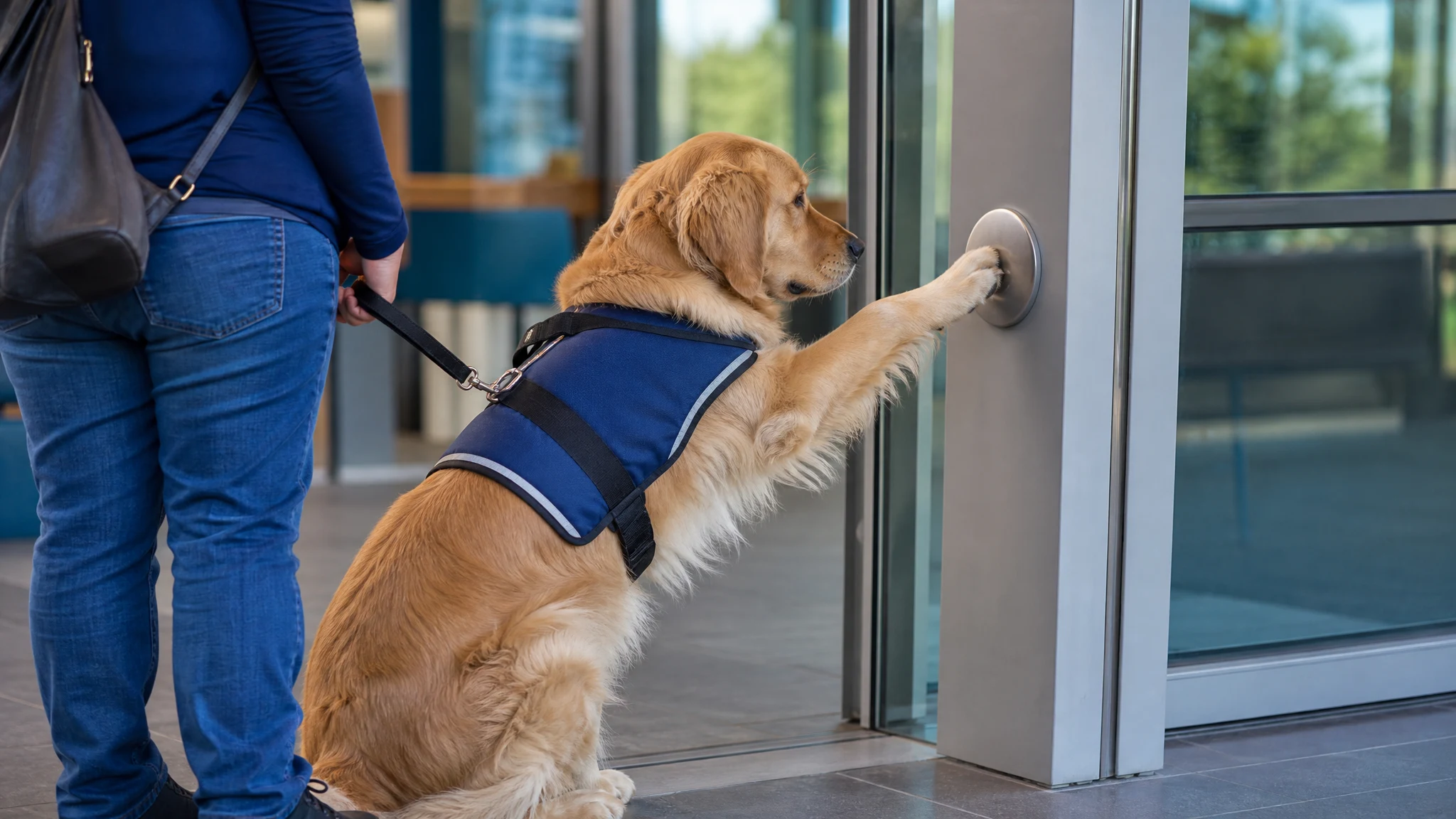
- Opening and closing doors or drawers with a tug strap.
- Providing counterbalance or bracing when the handler stands up, if the dog is suited to it.
- Pulling a manual wheelchair in some situations.
Hearing disabilities
- Alerting the handler to a doorbell, smoke alarm, alarm clock or a person calling their name.
- Leading the handler to the source of a sound.
Vision disabilities
- Guiding around obstacles, stopping at curbs and stairs.
- Finding doors, crosswalk buttons or an empty seat.
Medical conditions
- Alerting to a change linked to a condition such as low blood sugar, when the dog has been trained to do so.
- Staying with the handler during a seizure, fetching help or a phone, or activating a alert device.
- Retrieving medication or a drink on cue.
Psychiatric disabilities, including PTSD
- Interrupting a trained pattern of behavior, such as nudging or pawing when the handler shows signs of distress.
- Turning on lights or checking a room on cue.
- Creating space by standing or positioning beside or behind the handler in a crowd, on cue.
- Waking the handler from a nightmare.
Autism and developmental disabilities
- Interrupting repetitive or self-injuring behavior on cue.
- Staying with a child and helping prevent bolting, in programs that train for this.
Montana programs that place dogs, such as Dog Tag Buddies in Billings and K9 Care Montana in Livingston, serve groups including veterans, first responders and people with autism. Contact each program directly for current eligibility, fees and waitlists.
Why comfort alone is not a task
Many dogs make their people feel better. That is real and valuable, but under the ADA it does not make a dog a service animal. Emotional support, therapy and comfort animals are not service animals under the ADA, and Montana's definition in 49-4-203 excludes emotional support animals as well.
The line is between presence and work. A dog that calms its owner by being nearby is providing comfort. A dog that has been trained to press against the handler's legs on cue during a panic episode, or to interrupt a trained behavior pattern, is performing a task.
A useful test: could you describe the behavior as a specific action, taught on purpose, that the dog does in response to a cue or a sign? If the honest answer is that the dog just makes you feel safer, it is not yet a task.
What you need before you start
Materials
- A flat buckle collar or a well-fitted harness, and a standard leash.
- Small, soft, high-value treats, plus a treat pouch.
- A clicker or a consistent marker word such as "yes."
- A tug strap, retrieval objects or alert devices, depending on the task.
- A training log, either a notebook or a phone app, to record sessions.
- A dog with a stable, friendly temperament and good health. Not every dog is suited to service work, and that is not a failure on anyone's part.
Methods
Use humane, reward-based training, in line with the American Veterinary Society of Animal Behavior (AVSAB). Do not use shock, prong or choke collars, alpha rolls, scruffing or dominance methods. They raise stress and can damage the working relationship you need.
How to teach a task: step by step
- Define the task in writing. Write one sentence naming the disability-related need, the cue or trigger, and the dog's action. For example: "When I drop an item, the dog picks it up and puts it in my hand." If you cannot write it clearly, the task is not ready to train.
- Build the foundation first. Teach attention, sit, down, stay, come and loose-leash walking before any task. A dog that cannot settle or focus will struggle with complex behaviors.
- Break the task into small pieces. A retrieve, for instance, starts with touching an object, then holding it, then carrying it, then releasing it into your hand. Mark and reward each small step.
- Add the cue. Once the dog reliably offers the behavior, attach a verbal cue or hand signal just before it. For alert tasks, pair the behavior with the real trigger, such as a sound or a change in your body, rather than a spoken command.
- Add distance, duration and distraction one at a time. Change only one thing per session. If the dog fails, go back a step. Short, upbeat sessions work better than long ones.
- Practice in real settings. Move from your living room to the yard, then a quiet store, then busier places. Tasks that work at home often fall apart in public until you train there.
- Test the task when you need it. Make sure the dog performs the behavior when you are tired, stressed or in a new place, since that is when the task matters most.
- Keep records. Note dates, locations and results. Records help you see progress and give you something concrete to describe if anyone asks what your dog is trained to do.
The public access test, explained
A service dog public access test is an evaluation of how a dog behaves around people, traffic, food and distractions while out in public. Assistance Dogs International (ADI) publishes a public access standard that many programs and trainers use as a benchmark. ADI's Montana member listing currently shows Dog Tag Buddies in Billings.
The test is about conduct. It is not about tasks. A dog can pass a public access test with strong manners and still not be a service dog if it has not been trained to do work or tasks for a person with a disability.
It is a benchmark, not a legal requirement
This point causes a lot of confusion, so it is worth stating plainly. The ADA does not require a public access test, a certification or a registration. ADA.gov says staff may ask only two questions where the dog's role is not obvious: whether the dog is a service animal required because of a disability, and what work or task the dog has been trained to perform.
No official service dog registry exists under the ADA. Online registrations, ID cards and certificates are not legal proof of anything, and you do not need to buy one. Use the public access test the way trainers do: as a way to see whether your dog is ready for the public places you plan to go.
What the test is looking for
In general terms, the test checks whether a dog stays calm, responsive and controllable in public. Check ADI's current published standard for the exact items and scoring, since details can change. As a practical training goal, work toward a dog that can:
- Walk beside you without pulling, even past food, people and other animals.
- Settle under a table or at your feet for a sustained period.
- Ignore dropped food and friendly strangers.
- Stay calm around unusual sights, sounds and surfaces.
- Respond to your cues reliably, without constant repeating.
- Remain clean, housebroken and unobtrusive.
How to prepare for a public access test
- Choose a low-distraction place and run through the basics with the dog on leash.
- Practice quick, calm exits and entrances through doorways.
- Rehearse settling for gradually longer periods in a cafe, waiting room or store.
- Introduce busy sidewalks and vehicles at a distance, then reduce the gap.
- Ask a trainer or a program you trust to watch a practice run and give honest feedback.
What Montana law adds
Under MCA 49-4-214, a person with a disability may be accompanied by a service animal in the places listed in 49-4-211, with no extra charge, though the handler is liable for damage the animal causes. The animal must be under control. An animal that is out of control or not housebroken may be asked to leave, and the handler must still be offered the chance to take part without the animal.
Montana also covers service animals in training. Under 49-4-214, anyone training a service animal has the same rights and responsibilities as a person with a disability, and the statute does not limit this to professional trainers. A dog in training must wear a leash, collar, cape, harness or backpack with written identification that can be seen and read from at least 20 feet.
For housing, Montana Code Annotated 49-2-305 bars disability discrimination, and 49-4-214 gives a person with a service animal full and equal access to housing, with no extra charge for the animal. For a broader look at Montana programs, costs and rules, see our guide to service dog training in Montana: laws, programs and costs.
Tips and common mistakes
- Mistaking manners for tasks. A well-behaved dog is not automatically a service dog. Train at least one specific task tied to your disability.
- Skipping the foundation. Rushing into tasks before the dog can settle and focus leads to unreliable behavior.
- Training too long. Ten focused minutes beat an hour of frustration. End on a success.
- Using aversive tools. Corrections can make a dog anxious or reactive in public, which works against the goal.
- Practicing only at home. Dogs do not generalize easily. Train where you plan to work.
- Buying a registration or vest as proof. Gear is optional under the ADA and proves nothing. Time spent on training is time well used.
- Misrepresenting a pet. Under MCA 49-4-222, misrepresenting a service animal is a misdemeanor only if the person was first given a written warning and kept going to gain service animal rights. Fines are $50 for a first offense, not less than $75 or more than $200 for a second, and not less than $100 or more than $1,000 for a third or later offense.
- Retiring a struggling dog too late. If a dog is stressed or unreliable in public despite good training, it can be kinder to let it be a pet and start again with a different dog.
What to expect
Results vary by dog, handler and task. With consistent, reward-based practice, many dogs can learn simple tasks such as retrieving or door opening within a few months, though complex alert or interruption tasks often take longer. Reliability in public typically builds gradually.
A public access test may help you see where your dog is strong and where it needs more work, but passing one does not create legal status, and failing one does not take legal status away. No training plan can promise a particular outcome, and some dogs simply are not suited to the work.
If you are denied access
If a business or landlord refuses access in a way you think is unlawful, the Montana Human Rights Bureau in the Department of Labor & Industry investigates discrimination complaints in public accommodations and housing, where physical or mental disability is a protected class. Its phone number is 406-444-2884, or toll free 1-800-542-0807, and relay is 711. Contact the bureau for current filing rules. This article explains the law in general terms and is not legal advice.
Sources
- ADA.gov, Service Animals FAQs
- Montana Legislature, MCA Title 49, Chapter 4, Part 2
- Montana Code Annotated 49-4-203
- Montana Code Annotated 49-4-214
- Montana Code Annotated 49-4-222
- Montana Code Annotated 49-2-305
- Assistance Dogs International, Montana member search
- Dog Tag Buddies
- K9 Care Montana
- Montana Department of Labor & Industry, Human Rights Bureau