Service Dogs in Training in Montana: Do They Have Public Access?
This page explains the law in general terms. It is not legal advice. For a specific situation, contact the agency listed on this site or an attorney.
Yes, in many cases. Montana is one of the states that extends public access rights to a service animal in training. That matters, because federal law does not.
This guide explains what Montana law says, who it covers, what gear it requires and how to prepare for outings. It is a plain-English explainer, not legal advice. For a complaint or a specific legal question, use the agencies listed at the end.
The short answer
- The ADA protects dogs that have already been individually trained to do work or perform tasks for a person with a disability, according to ADA.gov. Its service animal FAQs do not create a public access right for a dog that is still in training.
- Montana law fills part of that gap. Montana Code Annotated (MCA) 49-4-214(1) gives a person with a disability the right to be accompanied by a service animal or a service animal in training in the places listed in MCA 49-4-211.
- Under MCA 49-4-214(3), any person who is training a service animal has the same rights and responsibilities as a person with a disability. The statute does not limit this to professional trainers.
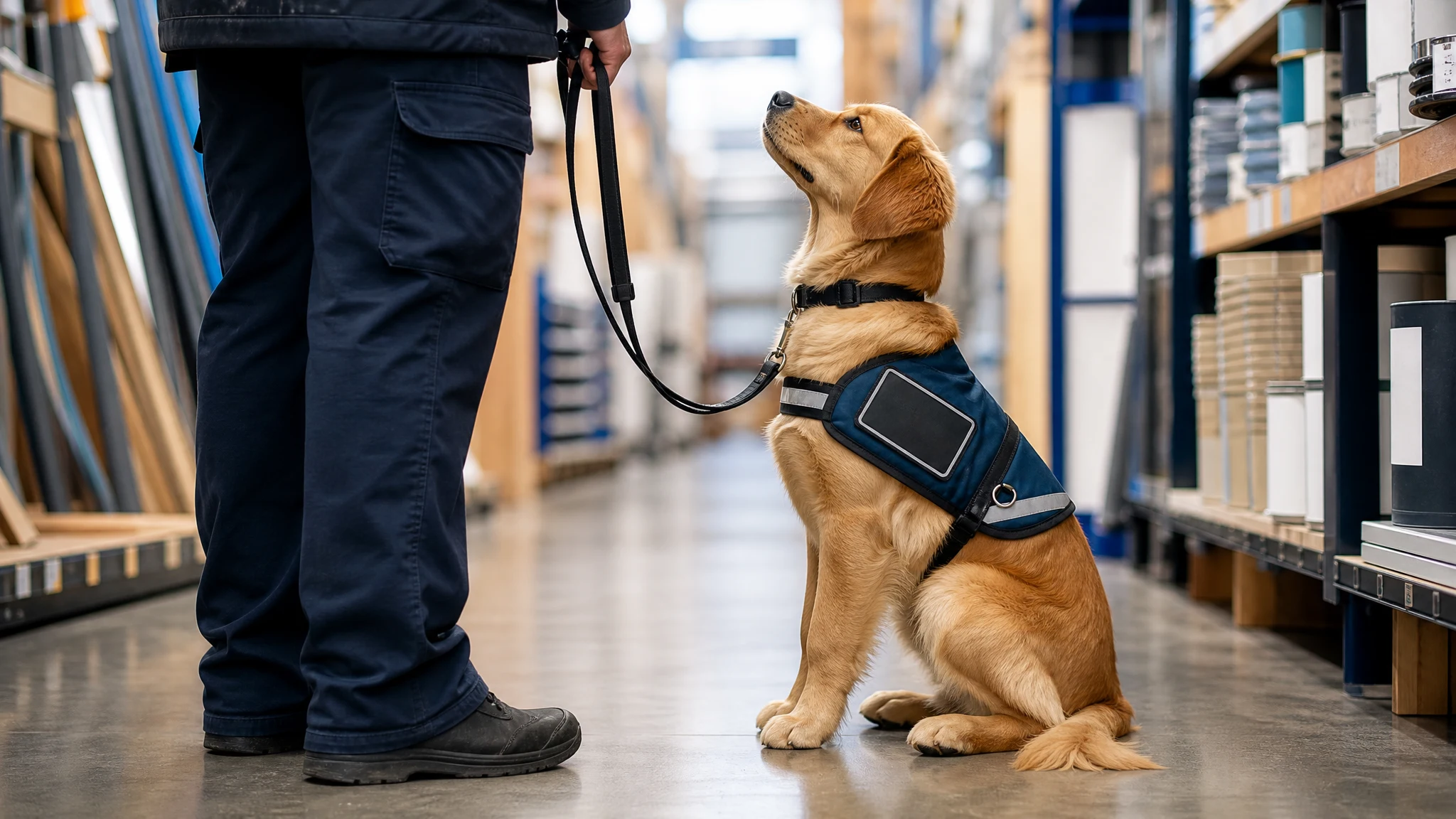
- The condition is gear. Under MCA 49-4-214(4), a service animal in training must wear a leash, collar, cape, harness or backpack carrying written identification that is visible and legible from at least 20 feet.
What counts as a service animal in Montana
MCA 49-4-203(2) defines a service animal as a dog or miniature horse individually trained to provide assistance to an individual with a disability. Emotional support animals are excluded.
The ADA is narrower on species. ADA.gov says a service animal is a dog individually trained to do work or perform tasks for a person with a disability. So Montana includes miniature horses in its state definition, while the ADA definition names dogs only.
Neither law treats emotional support, comfort or therapy animals as service animals. A dog that provides comfort by being present, without trained tasks, does not qualify. The same goes for a dog that is only "in training" to be a pet with good manners.
Who is covered in Montana
The Montana statute is broader than many people expect. MCA 49-4-214(3) gives "any person who is training a service animal" the same rights and responsibilities as a person with a disability. The statute does not require the trainer to be a professional, employed by a school or licensed in any way.
That means these people appear to fall within the text:
- A person with a disability who is training their own dog to perform tasks.
- A volunteer puppy raiser or trainer working with a program.
- A professional trainer.
The dog must actually be a service animal in training. The statute is about animals being trained to assist an individual with a disability, not a dog with no such purpose.
The section as reviewed does not set a minimum age for the dog or the handler. If age is a question for your situation, read MCA 49-4-214 on the Montana Legislature website or ask the agency listed below.
Where access applies
MCA 49-4-214(1) points to the places listed in MCA 49-4-211. That section covers public places and public accommodations as defined in MCA 49-2-101. In everyday terms, this generally means places open to the public, such as stores, restaurants, hotels and other businesses that serve customers.
Public accommodation is a legal term with its own definition. If you are unsure whether a specific place counts, check MCA 49-2-101 or ask the Montana Human Rights Bureau.
The Montana summary also says there should be no extra charge for the animal. The handler is liable for any damage the animal causes.
What you need
- A dog that is truly being trained as a service animal for a person with a disability.
- A leash and collar, or a harness, cape or backpack, that you can attach written identification to.
- Written identification that is visible and legible from at least 20 feet. A clear, large, high-contrast print is the practical goal.
- Treats or other rewards for reward-based training.
- A way to clean up after the dog, and a way to deal with any mess.
- A copy of, or a link to, MCA 49-4-214 on mca.legmt.gov for reference.
Do not buy a "registration," "certification" or ID card from a website and treat it as legal proof. The ADA has no official service dog registry or required certification, and Montana's training rule asks for written identification on the gear, not a registry record.
Step by step: preparing for public outings
Step 1: Confirm your dog fits the purpose
Ask yourself whether the dog is being trained to do specific work or tasks for a person with a disability. Examples under the ADA are guiding, alerting or retrieving, though your own situation will vary. If the dog is a companion or comfort animal, Montana's service animal rules do not apply to it.
Step 2: Set up the required identification
Under MCA 49-4-214(4), the written identification must be on a leash, collar, cape, harness or backpack, and be visible and legible from at least 20 feet. Try this check: have a helper stand 20 feet away and read it. If they cannot, make the lettering larger or higher contrast.
Read the statute's wording for any further detail. This guide does not add rules that the section does not state.
Step 3: Build skills at home first
Public access depends on control. Under MCA 49-4-214, the handler must keep the animal under control. An animal that is out of control or not housebroken may be asked to leave.
Practice the basics in quiet settings first: loose-leash walking, settling on a mat, ignoring dropped food and staying calm around people. Reward the behavior you want with treats, praise or play. This follows the reward-based approach supported by the American Veterinary Society of Animal Behavior (AVSAB). Avoid shock, prong or choke collars, alpha rolls, scruffing and other dominance methods.
Step 4: Start with short, easy outings
Choose a place that is open to the public and not too busy. Keep the first trip short and end it while the dog is still doing well. Slowly build up to longer trips, busier stores and harder distractions.
Step 5: Know what staff may ask
Montana's rule lets staff ask whether the animal is required because of a disability and what work or task it is trained to perform. ADA.gov gives the same two questions for places where it is not obvious that the dog is a service animal.
Answer calmly and briefly. For a dog in training, be honest that the dog is in training. Staff cannot ask for paperwork or a demonstration under the ADA's two-question rule.
Step 6: Be ready to step out
If the dog is out of control or not housebroken, the place may ask you to remove it. MCA 49-4-214 says the person with a disability must still be offered the chance to participate without the animal. Leaving calmly is part of good training and protects your relationship with the business.
Step 7: Know what to do if you are refused
Stay polite. A place that posts a no-animals notice must also state that service animals are permitted under the chapter, so you may point to that. MCA 49-4-215 makes it a misdemeanor to deny or interfere with admittance of a disabled person to those facilities.
If the problem is not resolved, you can contact the Montana Human Rights Bureau in the Department of Labor & Industry. It investigates discrimination complaints in public accommodations and housing, and physical or mental disability is a protected class. Its phone number is 406-444-2884, or toll free 1-800-542-0807, and relay is 711. Ask the Bureau about any filing deadline, because we could not confirm one.
Tips
- Treat your training outings like practice, not a right to push. Access depends on control, so leave if the dog is struggling.
- Keep the dog housebroken and clean. Plan potty breaks before you go in.
- Bring your own cleanup supplies. The handler is liable for damage the animal causes.
- Use a short, polite script. For example: "This is a service dog in training. It is being trained to help with a disability."
- Be kind to staff. Many employees have never heard of the training rule. A calm explanation goes further than an argument.
Common mistakes to avoid
- Assuming the ADA covers a dog in training. It does not. Your access in Montana comes from state law.
- Skipping the written identification. The 20-foot rule is a condition of access for a dog in training.
- Buying a registry or certificate. It is not legal proof and not required under the ADA.
- Calling an emotional support animal a service dog. Montana's definition excludes emotional support animals.
- Misrepresenting a pet as a service animal. Under MCA 49-4-222, misrepresentation is a misdemeanor only after a person has been given a written warning and keeps misrepresenting to gain service animal rights. Fines are $50 for a first offense, $75 to $200 for a second and $100 to $1,000 for a third or later offense. The court may also require community service for a disability advocacy organization.
- Using harsh tools. Shock, prong and choke collars and dominance methods go against AVSAB-aligned, reward-based training.
- Forgetting that the rules are about control. An untrained, unruly or not housebroken animal can be removed under MCA 49-4-221.
Housing and work are different
This article is about public places. Housing and employment follow other rules.
MCA 49-2-305 bars housing discrimination because of physical or mental disability, including refusing reasonable accommodations. The text of that section does not itself mention assistance animals. MCA 49-4-214(2), per its summary, gives a person with a service animal full and equal access to housing under MCA 49-2-305 and 49-4-212, with no extra charge for the animal but liability for damage. Whether this reaches a dog still in training is not clear from the sources, so ask your landlord in writing and check with the Human Rights Bureau.
MCA 49-2-303 makes disability a protected category in employment. The text reviewed does not mention service animals. If you want a dog in training at a workplace, talk with your employer early and ask the Bureau about your options.
What to expect
If you carry the required identification, keep control of the dog and stay courteous, you may find that most businesses allow the dog in. Some staff may still be unfamiliar with the Montana rule, and some conversations may take patience.
With steady, reward-based practice, many dogs become more reliable in public over time. Progress varies with the dog's temperament, your training plan and how often you practice, and no outcome is certain. Access can also be limited if the dog is not under control.
Finishing training and meeting the ADA definition is a separate step. Once the dog is individually trained to do work or tasks for a person with a disability, the ADA's protections apply to it as a service animal.
Where to find help with training
Several Montana programs work with service dogs. Fees, waitlists and eligibility vary, so contact each one directly.
- Dog Tag Buddies in Billings is listed as a member of Assistance Dogs International. It pairs veterans with shelter dogs. A KPAX report says its services are at no cost to the veteran.
- K9 Care Montana in Livingston says it offers all services at no cost to clients, with air transportation not included. It serves veterans, first responders and children with autism.
- Canine Companions is a national nonprofit that says its dogs and follow-up support are provided at no cost. Check with the organization about Montana service.
A Logan Health resource list also names independent trainers in Laurel, Helena, Frenchtown and Missoula. It is a hospital directory, not the businesses' own sites, so verify services and fees with each trainer directly.
Sources
- Montana Legislature, MCA Title 49, Chapter 4, Part 2
- Montana Code Annotated 49-4-203 (definitions)
- Montana Code Annotated 49-4-214 (service animal access and in training)
- Montana Code Annotated 49-4-222 (misrepresentation)
- Montana Code Annotated 49-2-305 (housing)
- Montana Code Annotated 49-2-303 (employment)
- Montana Department of Labor & Industry, Human Rights Bureau
- ADA.gov, Service Animals FAQs
- KPAX, Montana nonprofit helps veterans train shelter dogs